


Los Cipreses Honey Milenio by the Salazar Family, Costa Rica
- Regular price
-
69 kr - Regular price
-
- Sale price
-
69 kr
Couldn't load pickup availability
This is a beautiful lot of a honey processed Milenio variety produced by the Salazar family on their farm Los Cipreses, located in Naranjo, Costa Rica.
Country: Costa Rica
Region: Naranjo, West Valley
Producer: Salazar Family
Varietals: Milenio
Process: Modern Honey
Altitude: 1,650 MASL
This coffee underwent a modern honey process to produce this amazing sparkling cup with intense clarity.
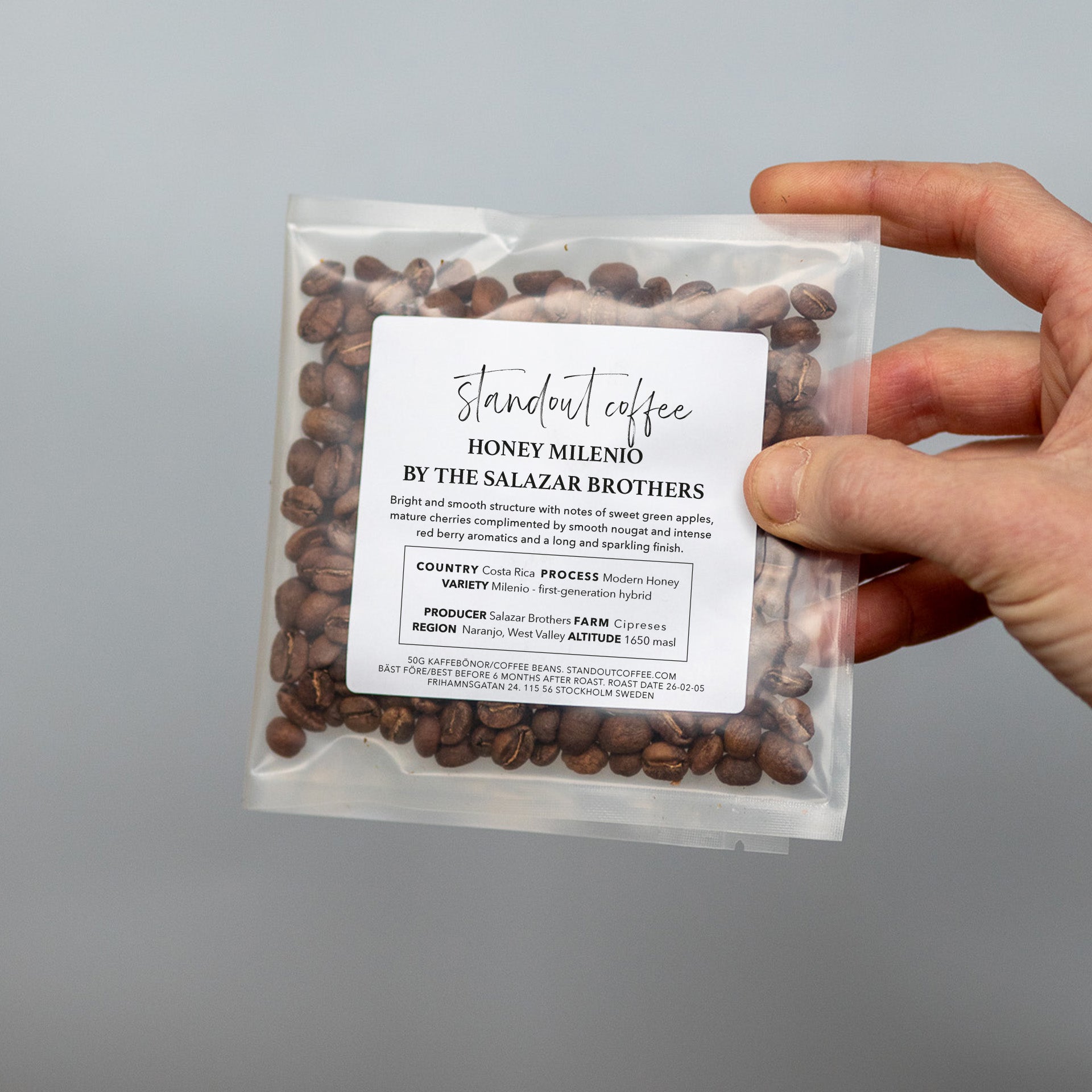
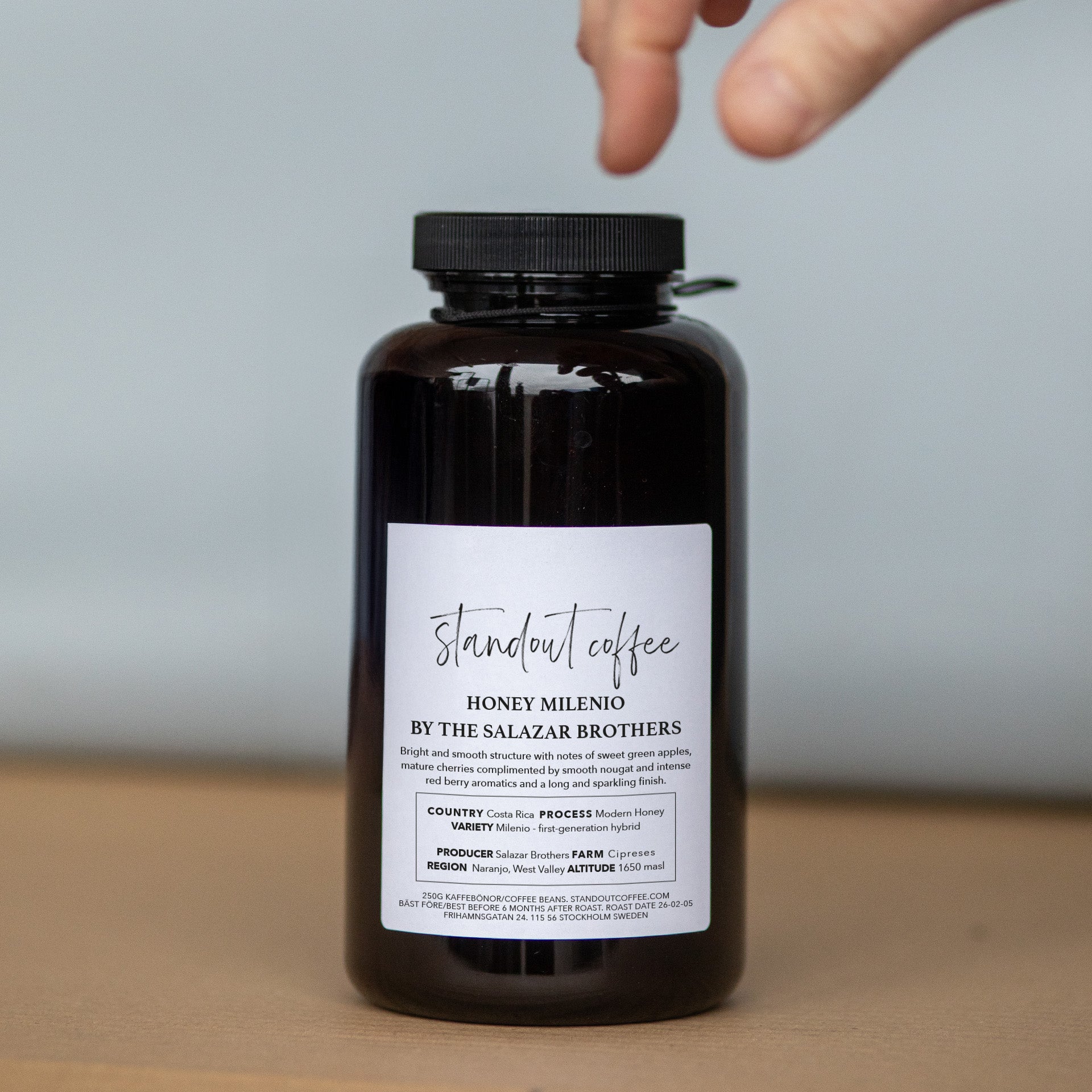
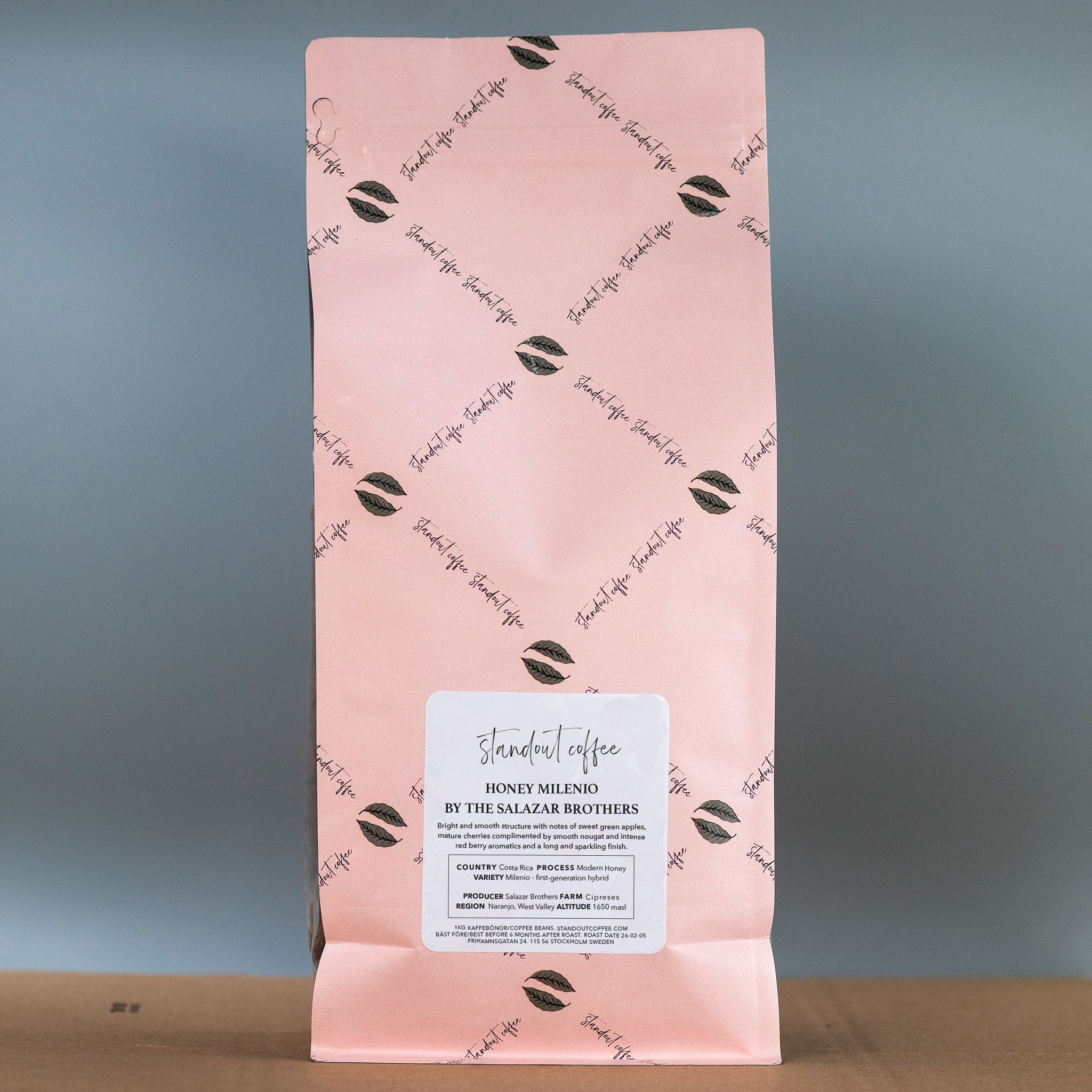
Taste description: Bright and smooth structure with notes of sweet green apples, mature cherries complimented by smooth nougat and intense red berry aromatics and a long and sparkling finish.
Naranjo is an especially beautiful part of Costa Rica, surrounded by lush forests that dance in the fresh winds coming from the Pacific Ocean. Here is where you will find Los Cipreses, originally founded by their father, the farm is now operated by brothers Christian and Greivan in Naranjo district of West Valley, Costa Rica. The west valley, as opposed to the Central Valley, tends to offer higher altitudes and, due to the influence of the Pacific Ocean weather patterns, a dryer and milder climate. Los Cipreses gets its name for the cypress trees that are grown next to the farm and sold as Christmas trees during the holidays.
Christian and his brother Greivan grow many different varieties on the farm including SL-28, Caturra, Geisha, Sudan Rume, and most excitingly, Milenio. Milenio is a newer hybrid variety, a cross between T5296 and the Ethiopian Sudan Rume, offering great resistance to leaf rust and providing a wonderful cup profile. These skills at growing combined with meticulous anaerobic processing create the outstanding flavours that you’ll find in this coffee.
Varietal: Milenio
- Milenio (also commonly H10) is a first-generation hybrid developed for specialty coffee quality and disease resistance.
- It’s a cross between the rust-resistant T5296 and an Ethiopian Sudan Rume landrace, combining hardiness with cup quality.
- Milenio has been gaining popularity in Costa Rica for its balanced acidity, aromatic complexity, and high yield under challenging conditions.
The Honey process entails 24 hours of resting in bags, cherries are depulped leaving all the possible musilage on the coffee beans.
The beans are placed in thick mounts in African Beds and left to dry for more or less 25 days. This will allow for the coffee to go through an aerobic fermentation, and a slow drying phase. This helps highlight the sweet and fruity notes.
Shipping information
- No EU import duties.
- Ships within 1-2 business days.
- Fully Tracked deliveries on all order.
- UPS and DHL available

Collections


“Standout Coffee operates at a level most roasteries talk about but rarely reach. The precision in their roasting is obvious from the first sip”
– Pierre V
FAQs
Amount of coffee
The Jar: Contains 250 grams of fresh roasted specialty coffee beans.
The Box: Contains 100 grams grams of whole competition style coffee beans.
The Big Bag: Contains 1000 grams of fresh roasted specialty coffee beans.
The Capsule box: Contains 10/50 biodegradable Nespresso compatible coffee capsules.
Roast Philosophy
Our coffees are roasted to shine both as filter brews and as competition-style espresso. They sit right in the sweet spot between specialty and competition coffees – clean, expressive, and precise.
If you’re a coffee bar or a private customer interested in learning more about our roast philosophy, or if you’d like something custom roasted for you and your clients, just leave us a note in the comments during checkout. We’ll be happy to get in touch.
How to brew
The Double Bloom | 15 g coffee/250 g water
⏱ 0:00-0:10 | 50 grams
⏱ 0:30-0:40 | 50 grams
⏱ 1:00-1:10 | 150 grams
Brew time for this recipe should be between 2:40-3:00!
Regarding extraction, this recipe results in a TDS value of 1,35 ≈ 20,5 % extraction.
Download our FREE V60 brew guide, The Double Bloom Recipe here: PDF or ePUB
Shipping with DHL Express Globemail
For international shipping: Once DHL Express has shipped your coffee out of Sweden they hand it over to the destination country's national post service.
If you have special delivery instructions or requests, please leave a note in your cart before checkout.