
The Science Behind SNAP
SNAP is a manual pour-over brewer designed to make filter coffee more consistent by addressing three common problems in pour-over brewers: bypass, inconsistent blooming caused by trapped CO₂ in the coffee bed, and loss of bed uniformity caused by air pockets.
Product Overview
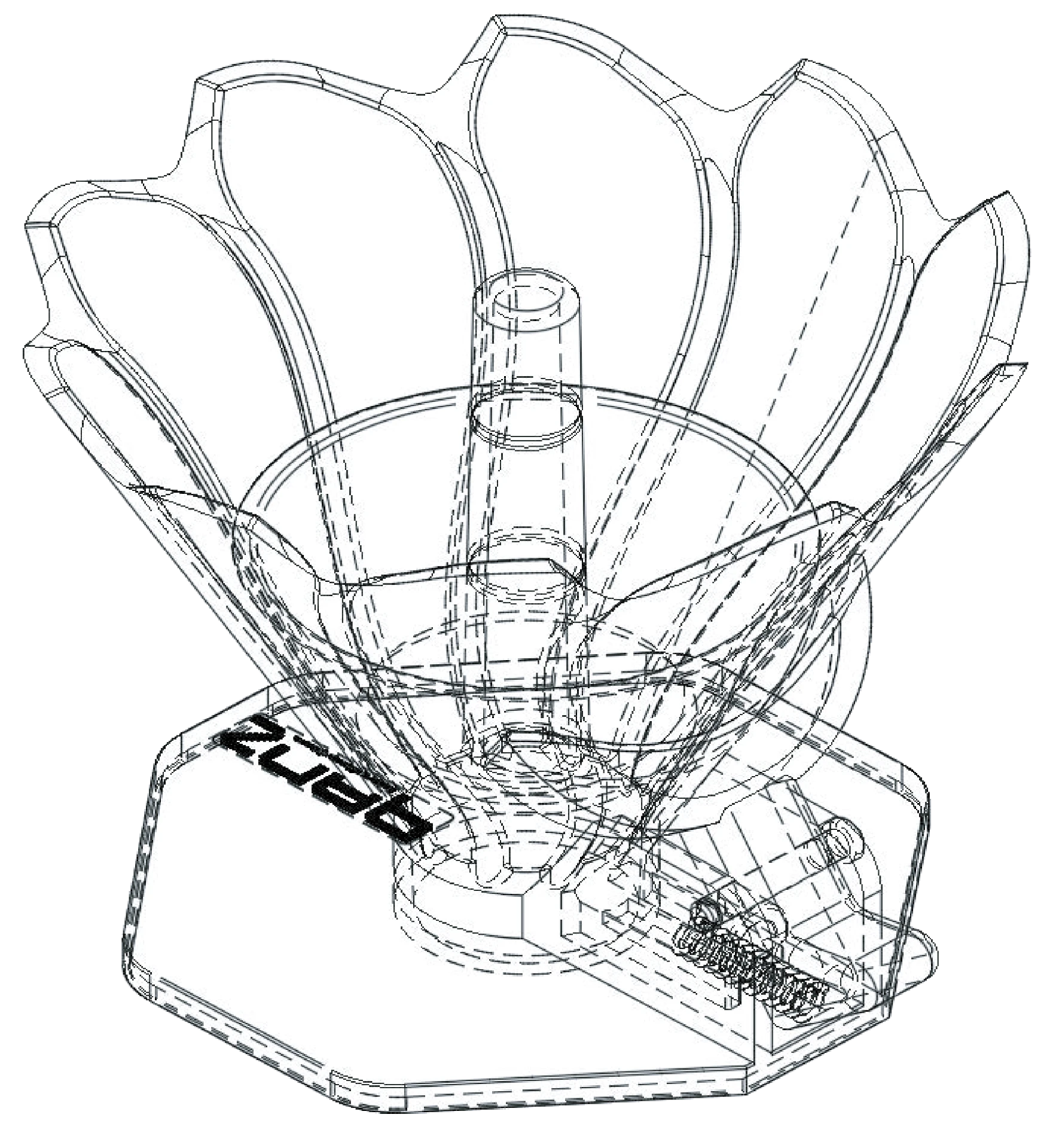
Snap's 10-channel curvature helps the paper filter stay evenly supported against the wall by raising the capillary adhesion of the filter paper, reducing bypass considerably. The sealed channels then act like exhaust vents, giving CO₂ and displaced air a clean route out, and letting you apply repeatable snaps during the brew.
These snaps help release trapped gas, saturate the coffee particles, and settle the bed. The force of the spring is tuned through computational fluid dynamics to evenly saturate the coffee particles with water whilst not creating fines migration and clogging. The result is a brewer that keeps the ritual of pour-over while reducing the volatility that normally comes from blooming, uneven wetting, and channeling.
Why the bloom is faster
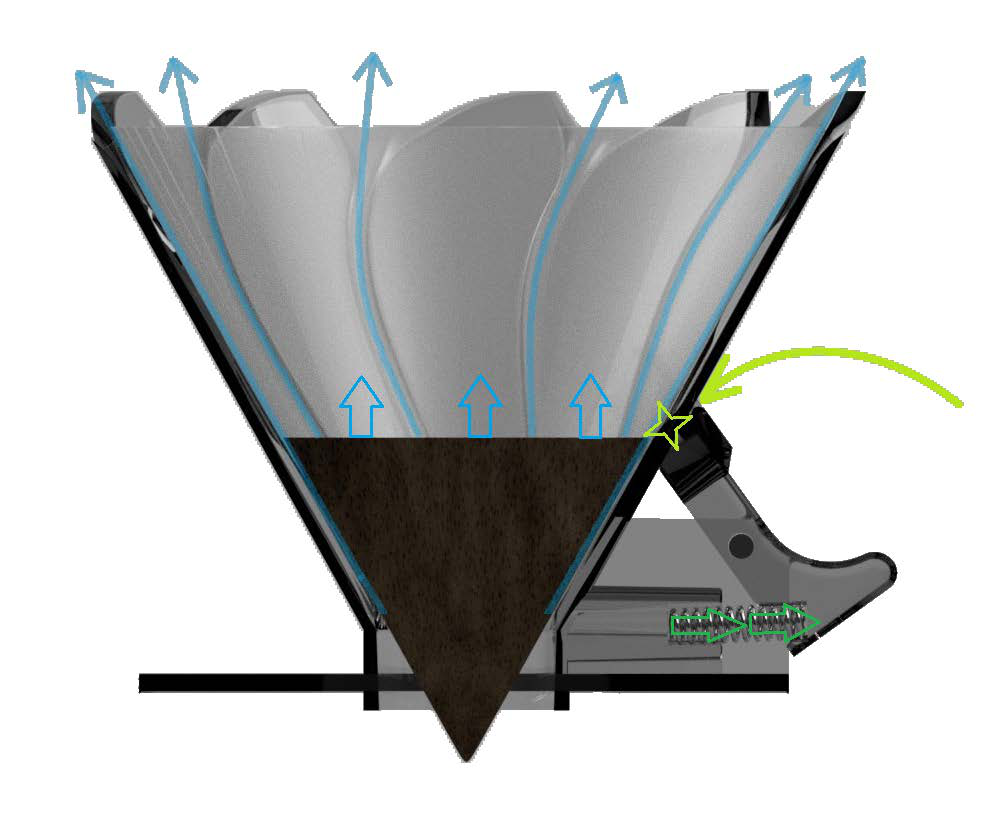
Fresh coffee releases CO₂ rapidly when hot water reaches the grounds. If that gas remains trapped in the coffee bed or behind the paper, it slows wetting and can push water toward easier paths. Snap gives that gas a cleaner escape route through the side-channel geometry.
Because CO₂ can leave faster, the bloom can finish faster and more evenly. This does not mean rushing the brew. It means the coffee reaches a fully wetted state sooner, with fewer dry pockets and less gas blocking water from entering the coffee structure.
How the snaps improve saturation
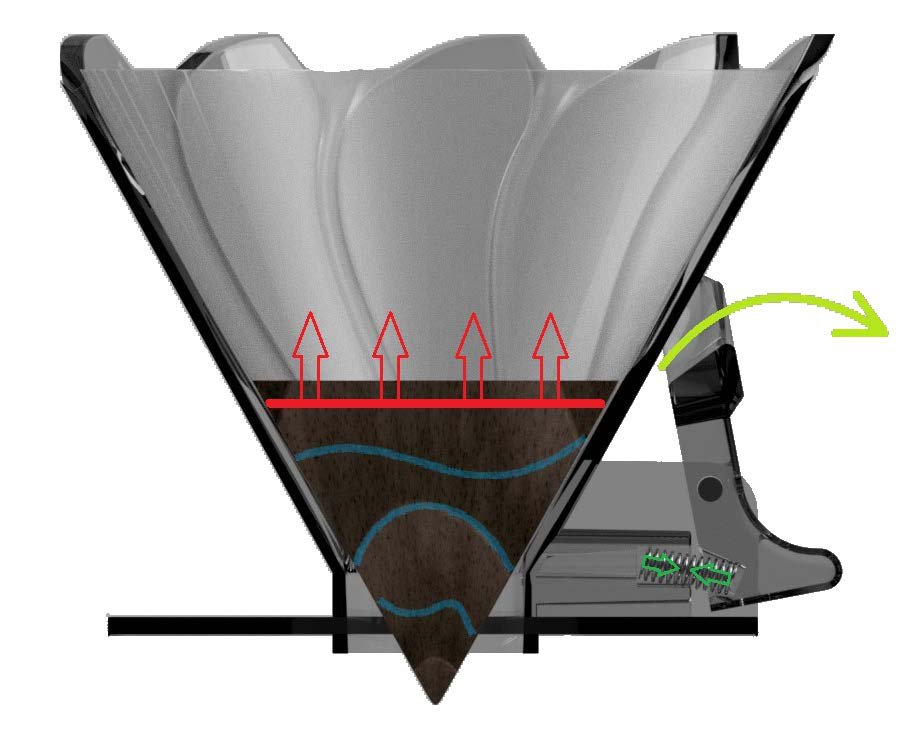
The SNAP sequence adds a short, repeatable mechanical impulse to the brewer. That impulse helps detach gas bubbles from the surface of coffee particles, breaks small air pockets inside the slurry, and encourages water to replace gas around and between the particles.
In practice, the bloom snaps help finish saturation early. The final snaps help settle the bed and clear remaining gas before drawdown finishes. The goal is not random agitation. The goal is repeatable particle–water contact.
How it works
1. Continuous side channels
The inner wall uses continuous, curved paths that support the paper while giving air and CO₂ a route to escape behind the filter. During bloom, this helps gas move upward and out instead of collecting behind the paper or under parts of the bed.
2. Capillary filter contact
Snap is designed so the wet paper stays closely attached to the brewer wall. This matters because bypass often happens when water finds a gap between the paper and the brewer instead of passing through the coffee bed.
3. Mechanical snapper
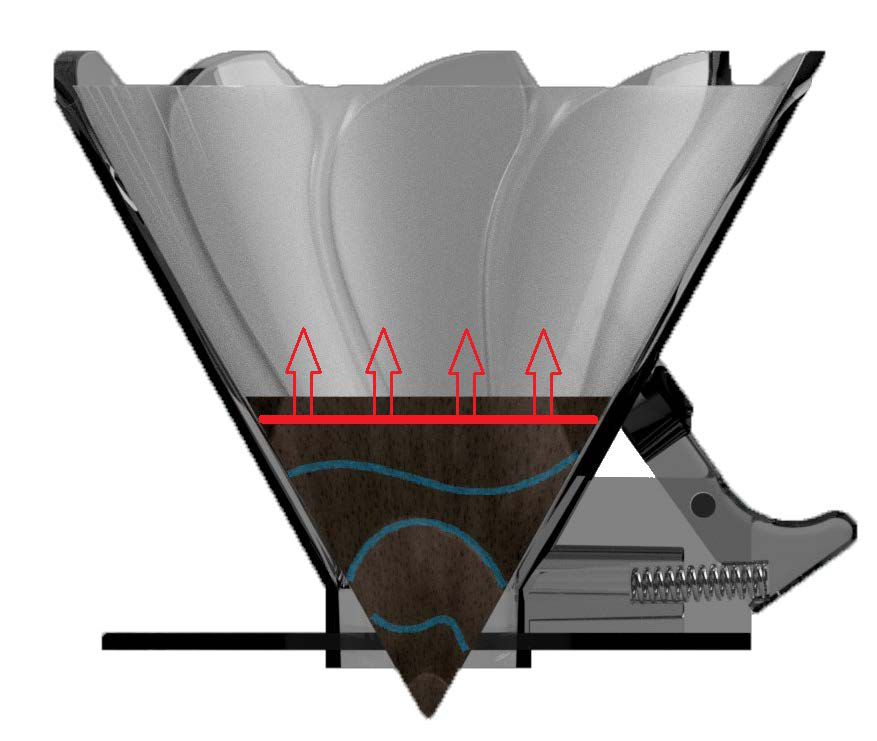
The integrated snapper gives the brewer repeatable snaps during brewing. These snaps help detach CO₂, collapse small dry pockets, improve saturation of the coffee particles, settle the bed, and clear remaining gas before drawdown finishes.
The stages of a snap
Simplified scientific explanation
In a coffee bed, water flow depends on bed permeability, bed thickness, water viscosity, and pressure difference. Trapped CO₂ reduces the effective permeability of the bed because gas occupies pore space that water should use. When resistance becomes uneven, water tends to move through easier paths instead of wetting the coffee uniformly.
Snap addresses this through passive geometry and active snapping. The continuous side channels give displaced air and CO₂ a path out while the wall geometry keeps the wet paper supported. The snaps apply a short mechanical impulse that helps detach bubbles from particle surfaces and allows water to replace gas in the slurry.
This promotes more uniform particle saturation by accelerating the replacement of gas with liquid at the particle surface and within the interstitial pore network. Because the mechanical input is delivered as a short impulse rather than continuous agitation, it increases transient fluid movement without substantially restructuring the coffee bed. This limits the advective transport of fines toward narrower pore throats, where they can accumulate, reduce local permeability, and create progressively larger pressure gradients across the bed. Because fines have a much lower settling velocity than larger particles, they remain suspended in the moving liquid for longer and are therefore more susceptible to being transported with the flow, while larger particles resettle more rapidly and largely retain the bed structure. The result is a more stable hydraulic structure, with fewer localised restrictions developing as extraction progresses.
The practical effect is better early wetting, faster bloom completion, improved particle saturation, and a more uniform bed before draw-down finishes.
SNAP benefits
- Faster and more complete bloom due to improved CO₂ release.
- Made out of TRITAN TX1001 for high impact and temperature resistance.
- 58° angle for a slightly deeper bed.
- More efficient early saturation of the coffee particles.
- Improved bed uniformity after the snap sequence.
- Lower bypass tendency from better paper contact.
- More repeatable brewing between users and between brews.
- A cup profile aimed at clarity, sweetness, and complexity without making the brew feel thin.
Recommended Starting Recipe
| Dose | 13.5 g coffee |
|---|---|
| Water | 220 g total brew water |
| Temperature | Around 91.5 °C |
| Filter | SNAP X SIBARIST FILTER, Origami Cone M or a V60 style paper |
| Bloom | Aggressive bloom, around 2.5x to 3x the coffee dose |
| Bloom time | 20 to 25 seconds |
| Snaps | 2 snaps during bloom and 3 snaps at the end of the brew |
Fresh Releases


Latest Arrivals
-
 Founder Selection X324-260220 Experimental by Ninety Plus Gesha Estates, PanamaFounder Selection X324-260220 Experimental by Ninety Plus Gesha Estates, Panama
- Regular price
-
7,499 kr - Regular price
-
- Sale price
-
7,499 kr
Quick view
-
 Afterglow by Jamison Savage Slow Dried Natural Gesha | Morgan Estate, PanamaAfterglow by Jamison Savage Slow Dried Natural Gesha | Morgan Estate, Panama
- Regular price
-
699 kr - Regular price
-
- Sale price
-
699 kr
Quick view
-
 Anthem Natural Gesha by Jamison Savage, PanamaAnthem Natural Gesha by Jamison Savage, Panama
- Regular price
-
545 kr - Regular price
-
- Sale price
-
545 kr
Quick view
-
 Iridescence Carbonic Macerated Washed Green Tip Gesha by Jamison Savage, PanamaIridescence Carbonic Macerated Washed Green Tip Gesha by Jamison Savage, Panama
- Regular price
-
499 kr - Regular price
-
- Sale price
-
499 kr
Quick view



Contact us
If you are interested in our products, competition coaching, roasted or green beans please contact us today, and we will get back to you as soon as possible.
If you have any questions or want your order on invoice instead please contact us by phone, mail or fill in the form below.