


Wilson Ortega Washed Pink Bourbon, Huila Colombia
- Regular price
-
59 kr - Regular price
-
- Sale price
-
59 kr
Couldn't load pickup availability
Amount of coffee
The Jar: Contains 250 grams of fresh roasted specialty coffee beans.
The Box: Contains 100 grams grams of whole competition style coffee beans.
The Big Bag: Contains 1000 grams of fresh roasted specialty coffee beans.
The Capsule box: Contains 10/50 biodegradable Nespresso compatible coffee capsules.
Roast Philosophy
Our coffees are roasted to shine both as filter brews and as competition-style espresso. They sit right in the sweet spot between specialty and competition coffees – clean, expressive, and precise.
If you’re a coffee bar or a private customer interested in learning more about our roast philosophy, or if you’d like something custom roasted for you and your clients, just leave us a note in the comments during checkout. We’ll be happy to get in touch.
Wholesale
Looking to buy larger quantities? Check out our wholesale section.
How to brew
The Double Bloom | 15 g coffee/250 g water
⏱ 0:00-0:10 | 50 grams
⏱ 0:30-0:40 | 50 grams
⏱ 1:00-1:10 | 150 grams
Brew time for this recipe should be between 2:40-3:00!
Regarding extraction, this recipe results in a TDS value of 1,35 ≈ 20,5 % extraction.
Download our FREE V60 brew guide, The Double Bloom Recipe here: PDF or ePUB
Shipping with DHL Express Globemail
For international shipping: Once DHL Express has shipped your coffee out of Sweden they hand it over to the destination country's national post service.
If you have special delivery instructions or requests, please leave a note in your cart before checkout.
Shipping with UPS
With UPS we can guarantee a fast and professional delivery service that makes sure you get your coffee fresh.



Product Details
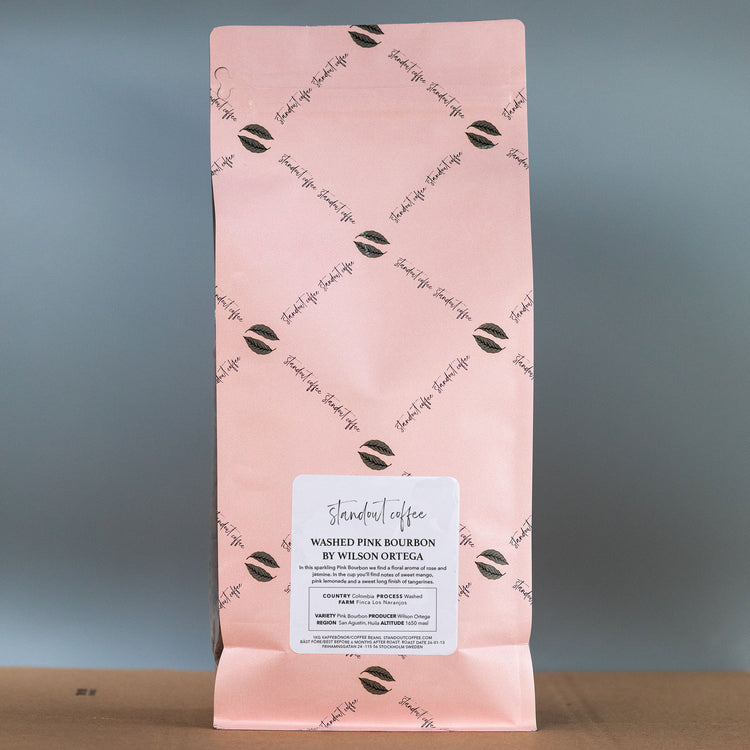
Taste description: Floral aroma of rose and jasmine. In the cup you’ll find notes of sweet mango, pink lemonade and a sweet long finish of tangerines.
Farmer: Wilson Jesus Ortega Muñoz
Region: San Agustin, Huila
Country: Colombia
Altitude: 1640 MASL
Varieties: Pink Bourbon
Process: Washed
Drying: Drying room 20 days
Story
Wilson Jesus Ortega Muñoz runs a 2-hectare farm called Finca Los Naranjos in the San Agustin area of Huila. Alongside around 2000 coffee trees, he also grows corn, bananas, and arracacha. Fly crop runs from June through August with the main harvest taking place from November through January. He produces around 1500 kgs of coffee per year.
In recent harvests, he has faced challenges from changes in the climate and the high costs of fertilizer and labor.
Harvest & process: the cherry is picked and left for 12 hours before depulping. Then it is put in tanks for 50 hours to ferment. From there the coffee is washed and taken to the drying room where it dries for around 20 days to reach the desired moisture content.